
Most of our repertoire is drawn from the puranas. Sanatana Sath Kriya began somewhere else — with an invitation to present at an international conference on Ayurveda, and a question that came with it: what does classical dance have to say to a room full of people who study the body for a living?
The honest answer turned out to be: a great deal, and it has been saying it for centuries without being asked.
The premise
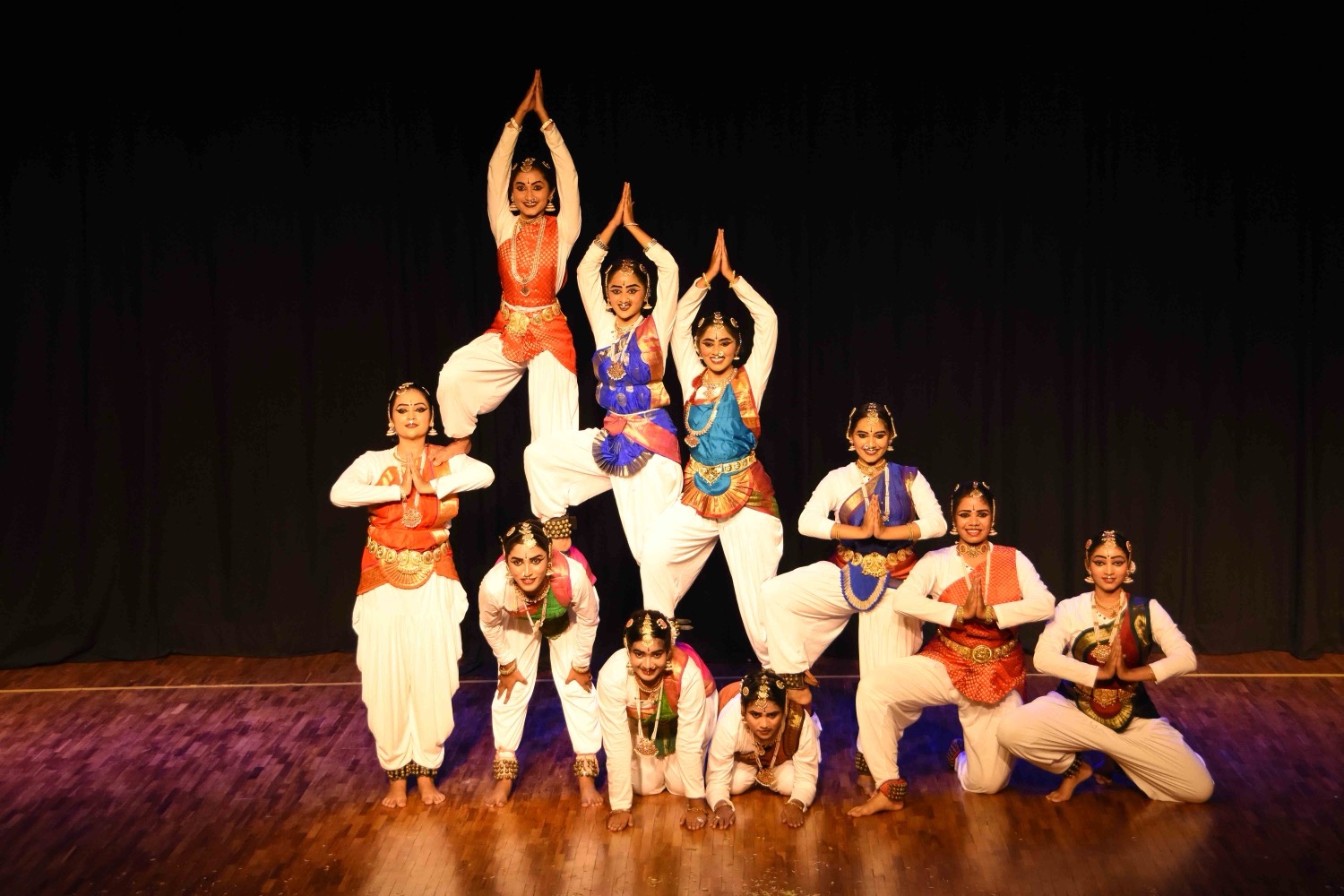
Sanatana Sath Kriya is a dance feature aligned with the puranas and with Ayurveda. It combines physical posture, breathing technique and meditation to address the physical, mental and spiritual aspects of a person at once — which is precisely Ayurveda's holistic approach to health, expressed through movement instead of prescription.
Its aim, as we describe it in the programme note, is to help a practitioner towards spiritual growth and self-realisation — echoing the puranic emphasis on devotion and on the pursuit of the cosmos — by interconnecting that pursuit with Bharatanatyam, India's ancient art form.
The dancer is not performing health. The dancer is practising it, in public, in fourteen-beat cycles.
What the form was already doing
Consider what a Bharatanatyam class asks of a body before anyone mentions wellness. Araimandi — the half-sitting stance the entire technique rests on — is a sustained isometric hold that builds the legs, the core and the alignment of the spine. The adavus train coordination, laterality and balance simultaneously. The hasta mudras ask for fine motor control that most adults lose by thirty.
Then there is what the form asks of the mind. A dancer holds a rhythmic cycle, a melodic line, a narrative and an emotional state at the same time, for minutes on end, without the tempo waiting. Concentration is not a side effect of this training. It is the training.
Sanatana Sath Kriya simply makes the connection explicit. It places yoga's postures and breathing beside the dance vocabulary they are cousins to, and lets an audience see that they were never really separate.
Why this is on our syllabus, not just our stage
Yoga is taught alongside dance at Nadavidyalaya, and it always has been. Not as a warm-up, and not as a fashionable addition. It is there because a dancer's instrument is their body, and a body that is trained only to perform will eventually fail at performing.
- Breath. A dancer who cannot control breath cannot control tempo, and cannot sustain abhinaya through a long varnam.
- Stillness. The pauses in a jathi are as expressive as the movement. Stillness is a trained skill.
- Longevity. Dancers who understand alignment keep dancing into their sixties. Dancers who don't, don't.
Theme-based work, more generally
Sanatana Sath Kriya belongs to a body of work Vidushi Mithra has built over the years for conferences and international meets: Vasudaiva Kutumbakam on climate change, Sustainable Development, Celebration of Grace on women's empowerment, Celebration of Connectivity for a hundred years of Rotary in India.
There is a risk in this kind of commission, and we are aware of it. A classical form asked to illustrate a policy theme can end up as decoration — a pretty envelope around somebody else's message. The discipline we hold to is that the vocabulary must not bend. If a proposition cannot be said in the language of Bharatanatyam, honestly and without improvisation from outside the form, then it is not a piece we should be making.
Sanatana Sath Kriya passed that test easily, because the thing it wanted to say was already inside the form. We only had to point at it.
Photographs from this and other productions are in the gallery. To commission a theme-based ensemble for a conference or institution, write to us.